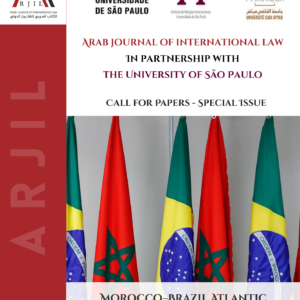
2026: Morocco–Brazil Atlantic Cooperation in Focus: An International Law Perspective
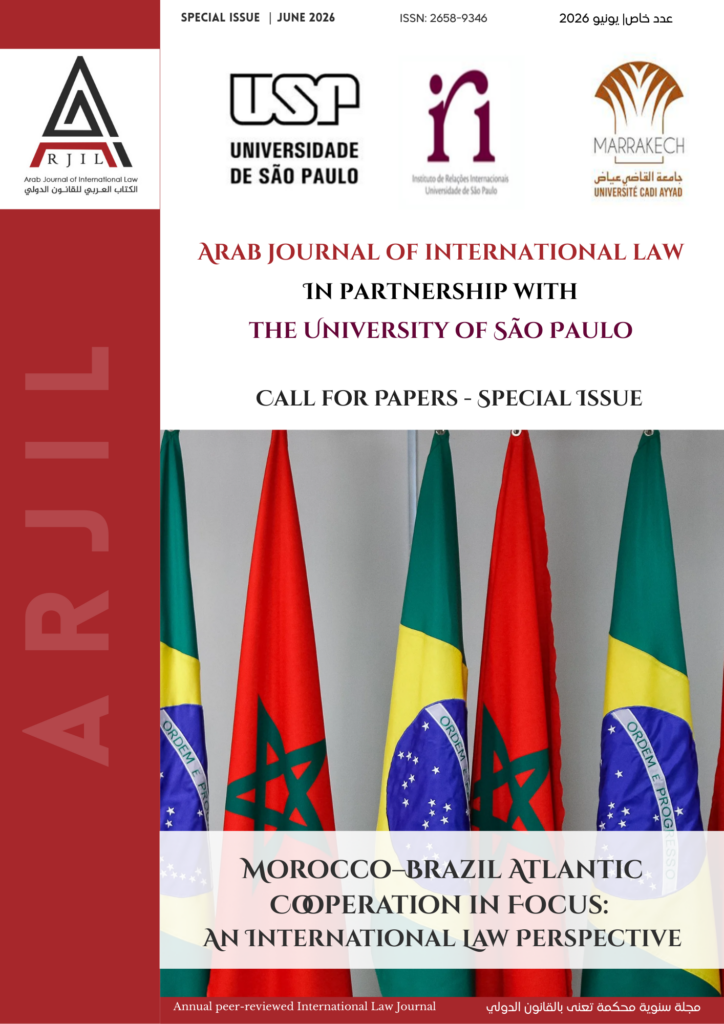
2026: Morocco–Brazil Atlantic Cooperation in Focus: An International Law Perspective
Background & Aims
Since the inaugural Conference of the Parties (COP) in Berlin in 1995, international climate negotiations have achieved significant milestones—including the Kyoto Protocol (1997) and the Paris Agreement (2015). Yet, they continue to face persistent challenges in addressing the accelerating climate crisis.
COP30, to be hosted in Belém at the heart of the Amazon—a region emblematic of global ecological vulnerability—represents a historic opportunity to reshape the global environmental paradigm.
As climate change intensifies, transatlantic collaboration between the Global South—particularly Morocco and Brazil—has become indispensable for advancing sustainable ocean governance, climate adaptation, and green transitions.
This special issue of ARJIL aims to:
- Explore legal, economic, linguistic, technological, and scientific synergies between Morocco and Brazil.
- Highlight innovative policies for marine conservation and blue economy development.
- Provide critical reflections to foster common solutions.
- Strengthen South–South cooperation and dialogue in the lead-up to COP30.
We welcome contributions from scholars, practitioners, and policymakers across disciplines.Suggested Topics
Submissions may address, but are not limited to, the following research themes:1. International Climate & Ocean Law
- Implementation of the Paris Agreement, UNCLOS, and the High Seas Treaty.
- Legal frameworks for marine biodiversity beyond national jurisdiction (BBNJ).
- International climate efforts and accountability mechanisms.
- Future climate partnerships between Africa and Latin America.
2. Law Enforcement & Environmental Accountability
- Mechanisms for enforcing international and regional climate commitments.
- The role of environmental courts, tribunals, and arbitration.
- Prosecution of environmental crimes and climate-related violations.
- Cross-border cooperation in combating illegal fishing, deforestation, and pollution.
- Strengthening institutional capacity and compliance monitoring in the Global South.
3. Morocco–Brazil Climate Partnerships
- Renewable energy collaboration (wind, solar, green hydrogen).
- Sustainable fisheries and coastal zone management.
- Climate litigation in the Global South.
4. Marine Ecosystems & Climate Adaptation
- Plastic pollution, coral reef protection, and marine protected areas (MPAs).
- Climate-induced migration and coastal resilience.
5. Green Finance & Innovation
- Climate funding mechanisms (loss and damage, carbon markets).
- Role of the private sector in blue economy projects.
- Climate finance in the post-Paris era.
6. AI & Digital Technologies for Climate Action
- Use of AI and big data in climate modeling, prediction, and risk assessment.
- Satellite monitoring and digital mapping for marine ecosystems and forests.
- Smart technologies for renewable energy and sustainable fisheries.
- AI in climate diplomacy, multilingual communication, and policy simulations.
- Ethical and governance challenges of AI in environmental management.
7. Diplomacy & Multilateralism
- South–South cooperation in UNFCCC negotiations.
- Local governance and indigenous ecological knowledge.
- Language of climate diplomacy and multilateralism.
8. Sociology & Climate Change
- Actors and strategies in addressing the climate crisis.
- Social movements and climate litigation at national, regional, and international levels.
- Public policies to mitigate climate impacts (environmental racism, poverty, food insecurity).
9. Linguistics & Climate Communication
- Discursive strategies in framing climate change in the Global South.
- Ecolinguistics and the “stories we live by” in climate discourse.
- Language of cooperation and conflict in Morocco–Brazil climate narratives.
- Translation, terminology, and multilingual climate communication across English, French, Portuguese, and Arabic.
- Role of linguistic framing in shaping public perception and environmental policies.
10. Security & Displacement
- Climate change as a security challenge in the Atlantic and Global South.
- Environmental stress, armed conflict, and geopolitical risks.
- Displacement and forced migration linked to climate impacts.
- Humanitarian responses to climate-induced insecurity.
- Regional cooperation mechanisms for managing climate-related displacement.
Target Audience
This call explicitly invites:
- Professors, researchers, and PhD candidates in climate law, marine policy, linguistics, environmental sciences, or related fields.
- Experts and practitioners from NGOs, international organizations, and governmental agencies working on ocean governance, climate adaptation, and sustainability.
- Early-career scholars offering innovative perspectives on South–South cooperation.
Submission Guidelines
- Languages: English, French, Portuguese, or Arabic.
- Deadline: Full paper submission (approx. 6,000 words) no later than January 30, 2026.
- Editorial guidelines: https://journals.imist.ma/index.php/ARJIL/
- Submission email: revue-arjil@uca.ac.ma
- Formatting: Footnotes must follow the Chicago Manual of Style (author-date or notes-bibliography). Ensure consistency in citation format throughout the paper.
Coordinators
- Capella Giannattasio Arthur, PhD, University of São Paulo (Brazil)
- Mohamed Benchekroun, PhD, Cadi Ayyad University, Marrakech (Morocco)
- Abdedaim Battoui, Editorial Member, Arab Journal of International Law (ARJIL)
- Samir El Firaa, PhD Researcher, Cadi Ayyad University, Marrakech (Morocco)
Special Committee
- Arron N. Honniball, PhD, Max Planck Foundation for International Peace and the Rule of Law, Utrecht University
- Abdelmalek El Ouazzani, PhD, Cadi Ayyad University, Marrakech (Morocco)
- Wania Duleba, PhD, University of São Paulo (USP)
- Danielle Rached, PhD, University of São Paulo (USP)
- Guilherme Almeida, PhD, University of São Paulo (USP)
- Samira Idellalène, PhD, Cadi Ayyad University, Safi (Morocco)
- Wilfried Djie, PhD, Catholic Institute of Toulouse
- Hinda Hedhili Azema, PhD, Bordeaux University (France)
Scientific Committee
- Elhoucine Chougrani, Cadi Ayyad University, Marrakech (Morocco)
- Ahmed Abozaid, Research Associate, University of Cambridge
- Brahim El Morchid, PhD, Cadi Ayyad University, Marrakech (Morocco)
- Mohamed Mliless, Independent Researcher in Ecolinguistics, Morocco
- Malzi Mohamed Jaouad, Cadi Ayyad University, Marrakech
- Adli Mohamed, Associate Professor, ENSA Oujda, Morocco
- Abdalwahab Kareem Hamed, Associate Professor, Sultan Qaboos University
- Salaheddine Kartobi, Cadi Ayyad University, Marrakech
- Aboulkasem Ziani, Professor of Sociology, Cadi Ayyad University, Marrakech
- Elhabib Stati Zineddine, Cadi Ayyad University, Marrakech
- Adli Moussaoui, Mohammed V University, Rabat
- Jawad Laaraich, Director of Economic Development, Marrakech
Arab Journal of International Law (ARJIL)
Email: revue-arjil@uca.ac.ma
Website: https://journals.imist.ma/index.php/ARJIL/